
I imagine there are very few people who have never experienced stress in their lives. In this article, I look at the various sources of stress and try to tease out important factors that might help us to avoid, recognise and/or manage it more effectively.
A Model of Stress
Everyone is familiar with the idiom “the straw that broke the camel’s back” and its derivative “the final straw”. It speaks to the cumulative effects of stress, the gradual build up of burdens until a breaking point is reached, often something that on its own is light and inconsequential. In engineering and construction, the load-bearing properties of materials and design structure are of vital importance. Every building and every bridge are built to withstand the expected stresses to which they will be subjected. Buildings in areas prone to earthquakes are designed to cope with a level of seismic shocks. Materials differ with regard to their load-bearing capacities – compare, for example, timber beams, rigid steel joists and concrete beams. When you enter a lift, it will tell you the maximum capacity it can handle. Similarly, trucks will have maximum loads they can carry. The concept of stress in the physical world is well understood.
We can use this concrete (sorry!) understanding to inform our use of the term “stress” in the psychological world. There are two sides to the stress equation. I will use a donkey instead of a camel – they tend to be more common in my neighbourhood:
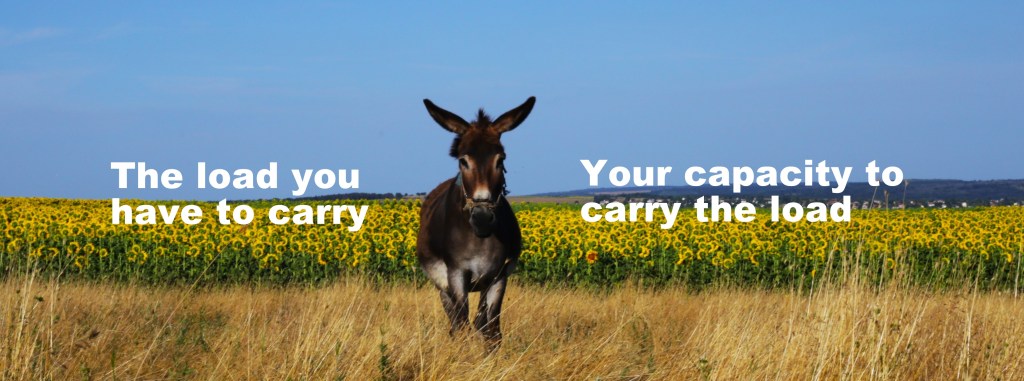
In psychological terms, I think demands and the resources to meet those demands more accurately capture the concept of stress. Everything is fine when when the former is less than the latter. One needs to start to be concerned as the point of equilibrium comes closer. Stress is experienced when demands outweigh resources.
Exploring the Model
The model allows us to dissect separately the two sides of the equation. We also need to consider the interactions between the two sides. It is natural to assume that these elements exist in the real world and that they can be objectively measured. However, unlike in engineering, there is a large degree of subjectivity. There is also inconsistency – a timber beam will behave tomorrow as it does today, but a person may not. Individual differences exist within people – behaviours change over time and in response to different environments – and between people – some may be more like steel joists while others are like timber beams fashioned to support varying loads.
Rather than thinking about demands and resources, it is more helpful to view these elements as perceived demands and perceived resources. It may be that what is expected of us is not the same as what we believe is expected of us. Similarly, our capacity to meet those demands may in reality be greater or less than is really the case. Thus, a first step towards recognising and managing stress in the workplace is learning how to make accurate appraisals of the situation. Our first understanding or appraisal of the two sides of the equation may not reflect the true nature of the situation.
Understanding Resources
The following resources are likely to be most key in our understanding of stress. We are mainly concerned with stress in the workplace, but these resources also play a role in other areas of our lives. I address possible interactions in the section about environments.
Temporal – there is never enough time to meet the demands.
Financial – there is never enough money.
Physical – you do not have the strength or energy to complete the task.
Emotional – you do not have the resilience or emotional reserves to meet the demands.
Knowledge and Skills – you do not have the knowledge or skills to complete the task.
Internal and External Factors
Employers have a duty of care under Health and Safety Legislation to do all they can to protect employees from work-related stress. If we consider the categories above, this means having adequate numbers of staff and physical resources such as space and equipment. It means having targets that are achievable with the resources provided (including realistic deadlines). It means ensuring that the people appointed to specific roles have the skills and knowledge to do the job – hence the importance of training, supervision, appraisals and continuing professional development. Many employers provide access to counselling and other occupational health services. These are external factors that are outwith the control of employees.
Employees can take steps to reduce the impact of work-related stress. As noted earlier, it is important to be able to appraise accurately both the demands and the resources needed to meet those demands. It is about appreciating the elements that contribute to a fulfilling life – interests and relationships outside work, eating habits, the use of alcohol, spirituality if that is important to you, exercise, fresh air, and sleeping well. Stress at work can impact all of these elements, so being aware of any changes could signal that something is amiss. You may seek advice and help within your company or organisation, or you may choose to go elsewhere. Asking for help is never easy, but it is an important first step towards preventing further difficulties.
A degree of self-knowledge is also helpful. For example, some of these traits might make you more prone to work-related stress:
Procrastination – this was a big one for me. It is not about being lazy, it is about having unhelpful priorities. When I was a student, it suddenly seemed more important to clean the grill than to work on my dissertation. Not only is the work not done, but you feel the stress of having the Sword of Damacles hanging over you.
Time Management used to be a big thing (I’m not sure if it still is), but while there may be some good strategies and ideas out there, the cynical part of me believes I spent more time reading about it than actually doing it.
Perfectionism – perfection takes time, and the latter is a scarce resource in the modern world. This does not mean not to do the best job possible, just to keep a healthy perspective. Often, good enough is good enough. It can also contribute to procrastination – I delayed writing reports because I thought they needed to be worthy of a Pulitzer Prize.
Unassertiveness – it is important to be able to say when you are not able to take on a task because you do not have the resources to complete it satisfactorily. Or to highlight external resource deficiencies. Your degree of agency in these situations will also depend on hierarchical and other environmental factors which are considered below.
Imposter Syndrome – the belief that you are not good enough for the job, that you shouldn’t be there. So why were you hired? Why are you still there? I know the answers – they made a mistake and have not yet caught on to it. It is likely that you need to work on your self-esteem. Not an easy challenge, but doable.
Environmental Factors
Every environment both elicits behaviour and shapes behaviour in a perpetual cycle of interactions. And each environment has its own set of demand characteristics, be it a workplace, a place of worship, a gym, a school or any other of a thousand places. We are looking here at the expected and acceptable behaviours, which could include how you dress, how you speak, and how you relate to others – be they work peers, other colleagues within the management hierarchy, the public, your customers or your clients. It is therefore important to understand the demand characteristics of your work place. These will depend on the type of work, the space in which it occurs, its structure and its processes. In other words, we are looking at the culture of the workplace.
All of the elements noted above could become a source of stress. Cultures change over time and so it is important to be aware of how this could affect you – specifically, with regard to how you respond and behave. I started my first job in the NHS in 1972 and witnessed many, many changes over the years until I fully retired around 5 years ago. I imagine this is true of the majority of work places now. There are sources of stress that did not exist or were in their infancy a few years ago. The pressure to do more with less, the advances in technology (a two-edged sword), the ability to be connected to work 24/7 with emails and smart phones, the rapid development of AI which is a big step into the unknown for most of us, and the ubiquitous quest for stars and ratings for every aspect of our performance.
Other sources of stress have sadly existed in the work place for many years, but hopefully as we become more enlightened they will eventually become part of history. In particular, I refer to bullying, harassment and scapegoating. These may take quite subtle forms, and I am sure there are other aspects of the work place that can contribute to a toxic culture. Sometimes, it could just be the behaviour and attitude of a few people, but at other times it might be something inherent in the structure and processes of the company or organisation. Too often it is the case that employees are made to feel responsible for failings that owe their origins to these systemic issues.
As work places change ever more rapidly, so it is important that we keep up and take care of ourselves, our colleagues and of all those for whom we are responsible. For many people, having a good life outside work offers relief and respite from workplace stress. Conversely, for some, work can be an escape from stresses elsewhere in their lives. For others, there is stress both at work and at home, meaning no respite. While we have our workplace selves and our home selves, we are just the same individuals in different environments, and the stresses from one can spill over into the other, creating a vicious cycle of escalating stress.
So, as a final point, it is really important to take a balanced view of the impact (both positive and negative) that Working from Home can have on your daily life. Your home has become your work place. I offer some helpful thoughts about this on my Keeping Well page.
 Understand Yourself Better