Caveat – Please note:
There are some psychological problems that are too severe or complicated to be amenable to self-help. If you feel this applies to you, then please seek professional help. This is particularly the case if you feel in danger of wanting to harm yourself or others – see crisis contacts.
Finding Your Way Around
The resources on this website have been developed around a series of workshops I ran for users of a local mental health charity. The site was hurriedly put together during the first covid lockdown and has since been refined and expanded. The workshops are effectively a short course in personal psychology, looking at how we understand and interact with the world around us. The more we understand what drives our behaviour, thinking and emotions, then the more we are better able to manage some of our problems.
The workshops can be accessed via the workshops tab or the downloadable PDFs tab. They are best viewed in sequence, but you can of course dive straight in if a particular topic strikes you as immediately relevant.
Material relating to alcohol can be found under the Alcohol tab. This is a section that is still under development.
The section on maintaining well-being looks at some simple strategies for maintaining good health. It was written to help people coping with the covid pandemic and working from home, but it has been updated to reflect the realities of today.
There is a separate section on relaxation, extolling its benefits and providing a short audio guided relaxation exercise.
The blog contains a whole series of posts on Dry January 2025. Other topics wilI appear as I start to post more frequently, including a bit more humour.
The Philosophy of Self-Help
The articles and resources on this website have the common purpose of helping people to develop a better understanding of themselves. Understanding is the first step towards improved self-compassion and change. Please explore and use the resources in ways that seem best for you – not everything will work for everyone.
I have reservations about the use of the term self-help. It conjures up images of people just being left to get on with it, trying to fix the problems in their lives to the best of their ability, as if there is no-one else around to help them. We are social animals, we seek the company of others. There are times when we help others and times when others help us, although some people find it hard to accept the latter. The original workshops I ran had the benefit of people coming together to get help but in the process they helped each other. The risk with self-help is that if it does not work then the person has only themself to blame. This is clearly unacceptable. As I noted at the start, some problems are so complex and entrenched that self-help is not an option. Also, we are fallible. We may know what we need to do but sometimes we find it hard to keep it going, or we don’t even try because we think it won’t work, or it seems too difficult. We are not robots.
The Role of Understanding
It is through understanding ourselves better that we are able to identify and put into practice changes that will lead to improvements in our lives. Philosophers down the ages have tried to understand the nature of humanity, looking at issues such as self-knowledge, truth, beliefs and goodness. Psychologists have contributed to the wealth of knowledge we have about how and why people behave and experience the world around them in the ways they do.
A Psychological Model
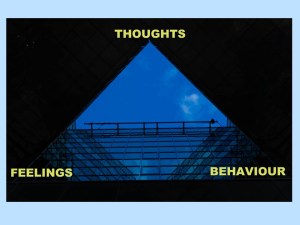
A lot of the content on Understand Yourself Better is based on a cognitive behavioural model of human experience. Cognitive Behavioural Therapy (CBT) is a well-established form of psychotherapy. Its underlying principles provide a very useful model (or framework) within which to understand our daily experiences. Primarily, we focus on the interactions between our thoughts, feelings and behaviour. We are then able to use this knowledge to “tweak” the system – for example, changing how a situation makes us feel by changing how we think about the situation.
We “…are disturbed not by things but by the views which [we] take of them.”
[Epictetus, A.D. 55-135]
Motivation, Change and Choices
If we want to make changes in the way we conduct our lives and to make choices that will bring us closer to our goals, then it is important we understand how these processes work. More about this later.
Self-Compassion
How often have you set out to make important changes in your life, only to find yourself giving up or returning to your old and familiar ways? Hopefully, the advice and guidelines you come across here will be realistic and non-prescriptive. What works for me may not work for you. Experiment and adapt. Small changes grow into bigger changes over time. As Winnie-the-Pooh observed…

“Rivers know this: there is no hurry. We shall get there some day.”
 Understand Yourself Better