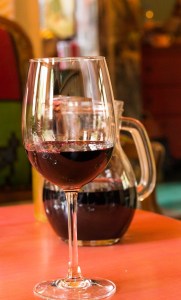
Here’s to alcohol, the rose colored glasses of life.
Today I want to take a look at looking. I have already noted in a previous post that alcohol, in common with all psychoactive substances, affects our emotions, thinking and behaviour. At the heart of these we find the key role played by perception. It is not the case that our sense organs project a multi-sensory representation of the world into our brains. The process of perception is active rather than passive. Reality is created in our brain by integrating and interpreting the mass of data that is being transmitted through a maze of neural pathways. The nature and quality of this data are in turn affected by how alert or drowsy we are, and by what is guiding our attention. At any given moment we are only conscious of a small fraction of what is happening around us and within us – oh, did I just feel a twinge in my knee and a little flutter in my tummy? An apposite reference here to the cocktail party effect – even if you are deep in conversation with someone, your attention will be activated if you hear your name being mentioned by someone else in the room.
Studies (e.g., Dal Lago et al, 2023) have shown that alcohol use is associated with an impaired ability to recognise faces. The inability to recognise faces is a neurological condition known as prosopagnosia. Could the effects of alcohol here account for the well-known beer goggles, and explain why everyone is a “best mate”?! But there is another side…
It has long been suspected that alcohol impairs the ability to interpret facial expressions of emotions such as anger, sadness and disgust. Several meta-analytical studies have produced mixed findings for this hypothesis. It has implications for how we understand violent behaviour among drinkers – apart from the obvious disinhibiting effects of alcohol, it is possible that misinterpreting someone’s non-verbal communications (through tone of voice, posture and, in this instance, facial expression) can lead to confrontations. While alcohol is undoubtedly a social lubricant that facilitates interpersonal harmony and bonhomie, the coin can quickly flip. Sorry for the mixed metaphors.
As we look deeper into looking, we have to give some attention to the condition known as delirium tremens (DTs, “the horrors”). This severe medical emergency caused by withdrawal from alcohol is characterised by confusion, agitation and hallucinations. Visual hallucinations are more common than auditory and tactile hallucinations, but all can occur. Which brings me neatly to my next topic….
Some people wonder if alcoholic drinks can be hallucinogenic – i.e., have the ability to produce hallucinations. The leading suspect in this respect is absinthe. It has a long and disturbing history, as eloquently described here. It is made from wormwood, which contains a substance known as thujone. This shows some molecular similarities to THC (the most active constituent of cannabis) and shows some affinity for cannabinoid receptors, but does not produce its intoxicating effects. Thujone levels in absinthe are too low to have any hallucinogenic effects. And as for beer – stories of hallucinogenic effects seem to be urban myths. And maybe rural myths too, because who doesn’t enjoy a pint in a country pub? Any hallucinatory and delusional effects of alcohol occur as a result of neurological damage arising from long term heavy use.
I have focused on visual perception in this post, but alcohol affects global cognitive abilities such as attention, executive functions (e.g., verbal fluency), inhibitory control, decision making, problem solving and memory. This sounds like a complete undergraduate course in Cognitive Psychology. I now wish I attended more lectures – there were difficulties getting there that I couldn’t overcome, I often forgot when and where they were, I found it difficult to concentrate if I was there, and I could never recognise the lecturer.
There is even evidence that alcohol affects our perception of time. January is certainly a longer month without alcohol. And to the future – I will look at other cognitive aspects of alcohol use. For now, keep safe and well.
Reference:
Dal Lago, D., Burns, E., Gaunt, E., Peers, E., Jackson, R. C., & Wilcockson, T. D. W. (2023). Alcohol Use Predicts Face Perception Impairments and Difficulties in Face Recognition.
Substance Use and Misuse, 58 (13), 1734-1741.
[Oooh, getting all fancy-pants academic now]
Alcohol Trivia Quiz
Yesterday’s answers:
1. A 7 pint keg of Watney’s beer to take to a party.
2. They are English hops (not a firm of solicitors).
3. Winston Churchill.
Today’s questions:
1. From whom is the opening quote for this post?
2. What is known as the “green fairy”?
3. What is the boiling point of alcohol?

 Understand Yourself Better