A week of abstinence already under my belt. Writing this blog has been a bonus for me – at a behavioural level it has given me an activity as an alternative to drinking in the early evenings and at a cognitive level it has led me to explore different aspects of alcohol and drinking. Through these mechanisms it has also led me to examine more closely my relationship with alcohol. When February comes, I will use some of the material to write more formally about alcohol under the C2H6O heading on this website. That will be with my professional hat on, worn at a suitably jaunty angle, drawing on my 25 plus years of working in addictions.
Yesterday I mentioned some of the reasons people drink (in relation to identifying risk factors for relapsing) and in an earlier post I noted that alcohol is a depressant of the central nervous system. There are many ways to classify psychoactive substances (those that act on the brain to bring about changes in perception, arousal levels, thinking, emotions and behaviour), but one of the simplest and most useful is in terms of how they affect your level of arousal. Depressants such as alcohol and benzodiazepines lower arousal levels – the more you consume, the less alert and more sleepy you become, leading in extreme cases to coma or worse. Conversely, stimulants increase your arousal level, making you more alert, active and excitable. Examples are caffeine, cocaine and amphetamines. Taken in high doses, they can lead to seizures and heart attacks. If you mix substances of the same classification you risk multiplying the effects and causing serious problems for yourself. Mixing of any sort carries risks. For example, taking alcohol and cocaine together can cause the body to produce a by-product (cocaethylene) that increases the risk of heart problems.
Given that alcohol is a depressant, how come it can make me happy and say or do crazy things? As with all substances, effects are dose-dependent – the more you take, the more affected you will be. Alcohol has a two-phase effect – in low doses, it actually depresses (reduces) the activity of the inhibitory pathways in your brain – those that when working normally stop you from saying outrageous things or doing something irresponsible. It is one of the reasons we drink – to be able to “let go”, to become disinhibited,to relax, to be less shy or socially anxious, to be life and soul of the party, to feel more confident (e.g., Dutch courage). As you continue to drink, so the depressant effect spreads – your words become slurred, your eyes lose focus, your movements become unsteady…and so on. In other words, you have reached the stage of inebriation. The writer P. G. Wodehouse had something to say about this – check out tomorrow’s post!
Alcohol Trivia Quiz
Yesterday’s answers:
1. A speakeasy was a bar selling illicit liquor during prohibition.
2. Thin Lizzy had a hit with Whisky in the Jar. [I will accept The Dubliners and Metallica!]
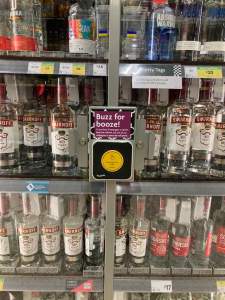
3. A tantalus is a lockable stand, often very decorative, to hold bottles of spirit. The feature image for this post is Morrison’s version of a tantalus to deter shoplifting. The original tanatalus was to stop servants from taking the spirits. The name comes from Tantalus in Greek mythology – he was punished by the gods by forever having water and food just outside his reach, Hence the word “tantalising”.
Today’s questions:
1. Which will lead to inebriation quicker – whisky or whisky and soda?
2. What makes whisky a bourbon?
3. Who had a hit with Champagne Supernova?
Thank you for getting this far. Quite a serious post today. Keep safe and well until next time.

 Understand Yourself Better